Concrete Design and Manufacturing Companies
Application Areas
Facade panels and precast elements
Facade elements with different dimensions, forms, and surface textures can be produced directly without the need for a mold process. Non-repetitive surfaces, complex geometries, and project-specific details are incorporated into production without additional labor. This both increases design diversity and significantly reduces mold production, inventory, and labor costs.
Decorative concrete products and architectural surfaces
Wall panels, interior claddings, and decorative elements with complex patterns, parametric surfaces, and custom geometries can be easily produced. Designs that are difficult or costly with traditional methods are brought to life quickly, in a controlled and repeatable manner with 3D concrete printing.
Interior applications and fixed furniture
Reception counters, seating elements, niches, display units, and project-specific fixed furniture can be produced. The boundaries between design and production disappear; you can create holistic, original, and characterful interiors in architectural projects.
Urban furniture and outdoor elements
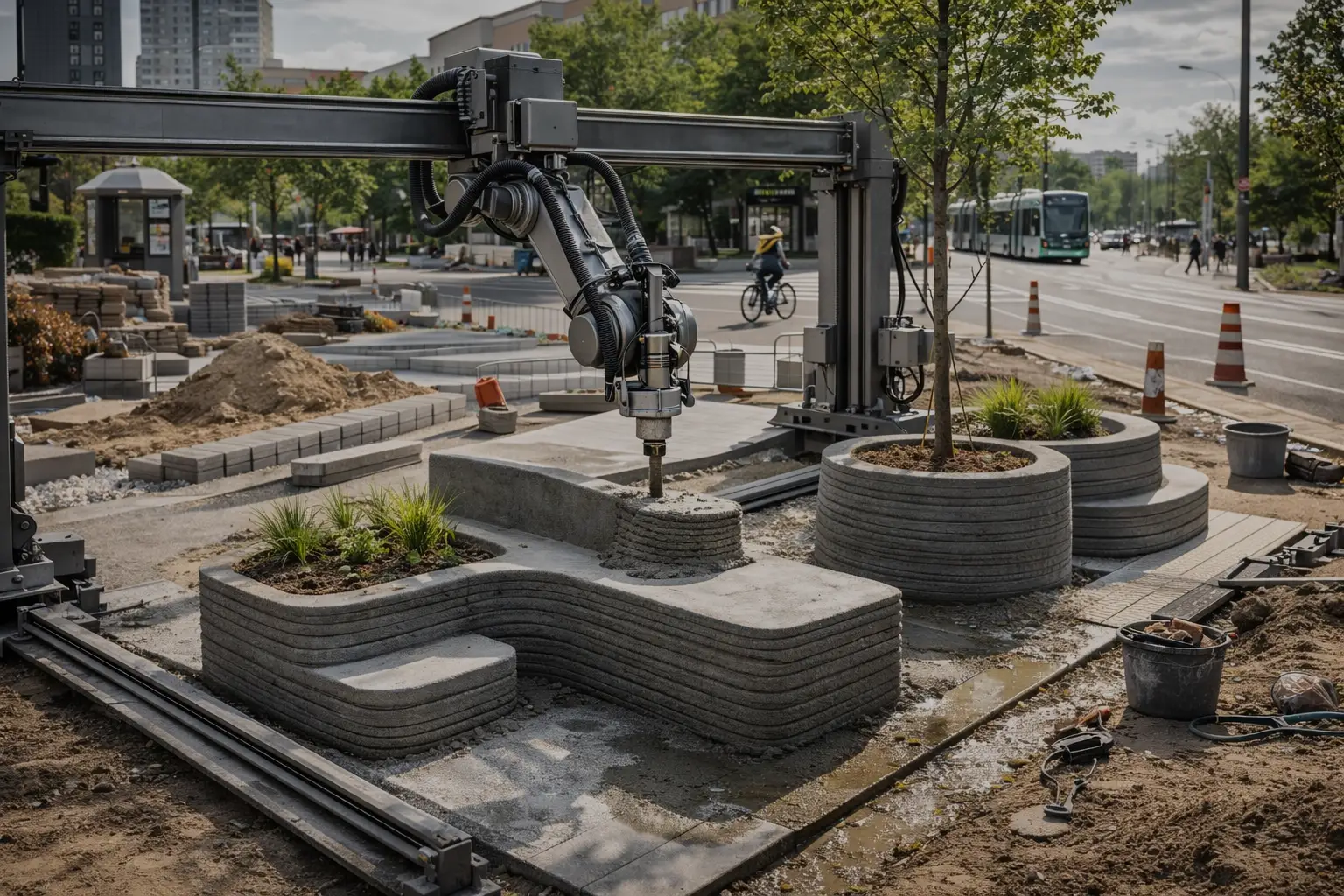
Benches, planters, seating groups, border elements, and landscape products can be produced both as standard and project-specific items. Gain production flexibility by quickly switching between different products on the same system, and respond rapidly to customer demands.
Infrastructure and technical concrete elements
Manholes, drainage channels, modular infrastructure parts, and technical concrete components can be produced with less labor, high precision, and in compliance with standards. Digital production reduces error rates and ensures quality continuity.
Low-volume and custom productions
Low-volume or one-off orders can be produced economically without mold costs. This makes previously difficult or costly jobs profitable, allowing you to reach new customer segments.
Defense industry and field applications
3D concrete printer technology can be used for trench structures, protective concrete elements, modular security walls, and structures requiring rapid on-site production. It provides operational efficiency by enabling quick installation and on-site production in challenging field conditions.
Key Advantages
The mold production, demolding, and intensive labor processes required in traditional manufacturing are eliminated. This reduces total production costs and increases operational efficiency.
With automation-supported production, you can achieve high production capacity with a limited number of operators. You reduce labor costs while increasing production efficiency.
Mold preparation, waiting times, and additional processing steps are eliminated. With direct transition from digital design to production, the production process accelerates and delivery times are significantly shortened.
Without standard production constraints, complex geometries and unique designs can be produced directly. The barriers limiting your creativity in architectural and technical projects are removed.
Since there are no mold costs, low-volume and custom productions become economical. This enables you to create new business models and reach new customer segments.
Solutions developed in design and engineering processes can be quickly produced and tested. This accelerates project development processes and reduces risks.
With direct digital-to-production output, error rates decrease, dimensional accuracy increases, and the same quality standard is maintained in every production run.
Start Production with 3D Concrete Technology — Complete your projects in less time, at lower cost, and with more flexible production models.
Our References








Shape the Future of Concrete
Set a new standard on-site with 3D concrete printing systems and integrated production solutions.